Feb 5, 2026
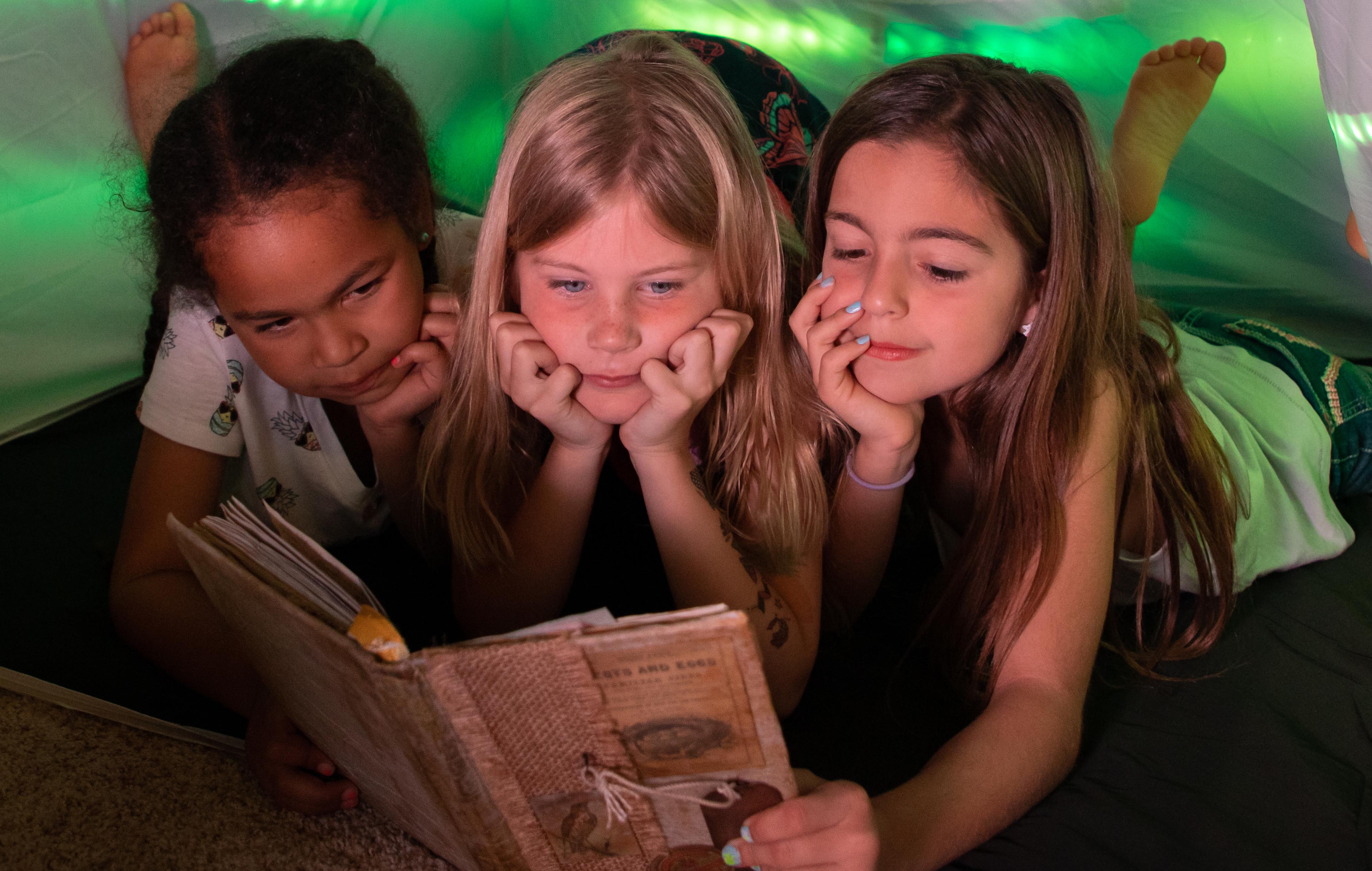
Before a child can imagine, create, or communicate, their nervous system must feel safe and regulated.
For decades, education has prioritized efficiency, standards, and measurable outcomes. Worksheets over wonder. Answers over imagination. But a growing body of research — and lived experience — points to something we’ve quietly lost along the way: story.
As explored in Psychology Today, storythinking isn’t about telling better stories. It’s about thinking through narrative — using characters, cause-and-effect, emotion, and imagination as the scaffolding for understanding the world. And it turns out this way of thinking is foundational not just to creativity, but to resilience, problem-solving, and emotional regulation.
At Burble Creativity, we couldn’t agree more. In fact, storythinking is the backbone of everything we build.
What Is Storythinking?
Storythinking is the cognitive process of organizing experiences into narrative structures. It helps us answer questions like:
What’s happening?
Why does it matter?
What could happen next?
Rather than memorizing isolated facts, storythinking allows learners to integrate emotion, context, and meaning. This is how humans have learned for thousands of years — long before standardized tests or digital screens.
And importantly, storythinking is how many neurodivergent minds naturally process the world.
Why Storythinking Builds Resilience
Resilience isn’t about “toughing it out.” It’s about making sense of challenge.
When children engage in storythinking, they learn to:
See obstacles as part of a larger arc
Understand that struggle doesn’t mean failure — it means transition
Imagine multiple outcomes instead of fixating on one
This is especially powerful for autistic and neurodivergent learners, who are often asked to adapt to environments that don’t adapt to them. Storythinking provides a safe internal structure — a way to process uncertainty without overwhelm.
Creativity Follows Regulation
Here’s a truth that’s often overlooked: creativity doesn’t emerge from chaos.
Before a child can imagine, create, or communicate, their nervous system must feel safe and regulated. The Psychology Today article highlights how storythinking supports emotional integration. At Burble, we take that one step further.
We design regulated environments — physical and digital — where story can do its work.
Soft boundaries before open-ended play
Sensory safety before expressive freedom
Emotional grounding before language expectations
Because regulation isn’t the opposite of creativity. It’s the prerequisite.
Storythinking and Neurodivergent Learners
Too often, disengagement in neurodivergent children is framed as an attention problem or a motivation issue. It’s neither.
Disengagement is frequently a regulation problem.
When environments are overstimulating or unpredictable, the brain shifts into survival mode. Storythinking pulls the brain back into coherence. Narrative gives experience a beginning, middle, and end — reducing cognitive load and increasing engagement.
That’s why storytelling isn’t an “extra” at Burble. It’s the engine.
Reimagining Learning Through Story
The takeaway from storythinking is simple but radical:
Learning works best when it feels meaningful.
When children see themselves as characters in a story — capable of growth, change, and imagination — resilience and creativity follow naturally.
At Burble Creativity, we don’t start with curriculum.
We start with regulation.
Then story.
Then everything else becomes possible.